Chapter 5
The Link and the Memory Map
Everything in the previous two chapters ends with bytes arriving in a Commodore's memory. This chapter is about that arrival: how the bytes get there, where they land, how c64cast avoids sending the ones that have not changed, and what a frame can afford.
None of it is required to use c64cast. It is required to reason about why a scene is slow, why two features refuse to run together, and what a picture costs before you ask for it.
Getting Bytes In#
The link is split by what each operation costs.
Writes go over the Ultimate DMA Service — a persistent TCP connection on port 64, one command per write, about 5 ms each and roughly 200 a second sustained. The connection opens when the run starts, so a machine with the service switched off fails immediately with an actionable message rather than halfway through the first scene.
Reads, resets, program launches and the startup probe go over REST. They are low-rate and one-shot, so the HTTP path's throughput does not matter — and they have no DMA equivalent.
That split is not a preference. The Ultimate's HTTP server closes the connection on every response and refuses keep-alive, so each request pays a fresh TCP handshake, and it serializes concurrent requests internally. Measured on a wired LAN:
| Transport | Per-write latency (avg / p50 / p95) | Sustained |
|---|---|---|
| REST | 14.0 / 14.8 / 19.9 ms | ≈71 writes/s |
| Socket DMA | 5.3 / 5.0 / 6.8 ms | ≈200 writes/s |
Throwing threads at REST makes it worse — eight parallel writers measured 65 writes a second, because they queue at a single-threaded server and pay eight TCP setups to do it. The persistent socket is the whole difference.
The DMA service accepts one connection at a time. That is why the audio path and the render path share a single client rather than opening a socket each: a second connection is accepted but not answered while the first is open. On firmware before 3.15 the first one was also seen to hold new connections off for several seconds after it closed; 3.15 serves the next one at once. From 3.15 the machine also drops a connection that has been idle for a second. c64cast checks for that before every write and reopens the connection first, about 7 ms, so a pause in a slideshow costs a reconnect rather than a write. The --profile latency line counts those as reconnects=. The shared client serializes commands with a mutex, and the combined rate — audio about eight writes a second, render thirty to sixty — sits well under the ceiling.
The TeensyROM Link#
The other backend speaks its own protocol over USB serial or TCP, both at about 106 KiB/s. There is no REST surface, so the operations the Ultimate does over HTTP happen differently: a program is uploaded and launched over the same link, and the SID player is started by swapping the interrupt vector so the next kernal interrupt runs it — no reset, no boot, and therefore none of the races that come with one.
Reading memory needs cycle-clean firmware (v0.7.2.5 or later). Without it the keyboard poller, the on-C64 menu and the character-ROM dump are unavailable, and c64cast says so rather than failing later.
What Each Backend Can Do#
Several features are gated on a capability rather than on a backend name, and a configuration that asks for one the machine lacks is degraded with a warning rather than refused:
| Capability | Ultimate | TeensyROM+ |
|---|---|---|
| Memory writes | ✓ | ✓ |
| Memory reads | ✓ | firmware v0.7.2.5+ |
| Reset, program launch | ✓ | ✓ |
| Expansion memory (REU) | ✓ | — |
| Device configuration API | ✓ | — |
| Ultimate Audio sampler | ✓ | — |
No REU means no staged video, no expansion-memory audio pump, and no buffered ASID ring player; those settings are forced off on such a backend, and --doctor reports it. No configuration API means SID address routing, model matching, panning and mixer levels are all no-ops — a multi-SID tune still draws every chip's scope, but only the first is audible.
What Each Firmware Can Do#
Some features depend on what an Ultimate's firmware answers rather than on which backend it is. c64cast asks for each of them at runtime and never reads a version number to decide, so a machine whose firmware picks a feature up later gets it then without a c64cast change. Ultimate 64 firmware 3.15a answers all of the ones below, and C64 Ultimate firmware 1.1.0 answers none of them.
| Feature | Ultimate 64 firmware 3.15a and later | Ultimate 64 firmware before 3.15a | C64 Ultimate firmware 1.1.0 | Without it |
|---|---|---|---|---|
Live palette read, for host_palette = auto |
✓ | — | — | The Ultimate 64's built-in palette is assumed, with a warning when the machine has a custom .vpl loaded |
Palette push, for [color].hardware_palette = "source" |
✓ | — | — | Scenes show the machine's own palette, after one warning |
Vol Master, the mixer's master level: read when deciding whether audio is audible, and raised from OFF for a run that wants audio |
✓ | ✓ from 3.15 | — | Nothing to read or raise; every source plays at its own level |
| Closes a DMA connection idle for one second | ✓ | — | — | Nothing to recover from: the connection stays open, and the check before each write finds it alive |
Telling that the Ultimate menu is open, in --doctor and at startup |
✓ | ✓ from 3.15 | — | No warning: an open menu takes the keyboard and hides the picture with nothing on the host side to say why |
The [midi_control] joystick action, driving a launched program's joystick ports |
✓ | ✓ from 3.15 | — | The mapping does nothing, with one warning per launcher scene |
The palette read goes over the Command Interface, and is asked of an Ultimate 64 only: an Ultimate II+ drives a real VIC-II, so auto assumes that rendering without asking. Chapter 3 has the rest, under "Near To What — [hardware].host_palette".
Vol Master is also in an Ultimate II+'s Audio Output Settings from firmware 3.15. On both machines c64cast looks for the setting itself, and Chapter 4 explains what it does with it, under "The Ultimate Audio Sampler".
What Lands in Memory#
c64cast writes into a real Commodore's 64 KB, alongside a running BASIC program and the kernal. What follows is what it claims, and why.
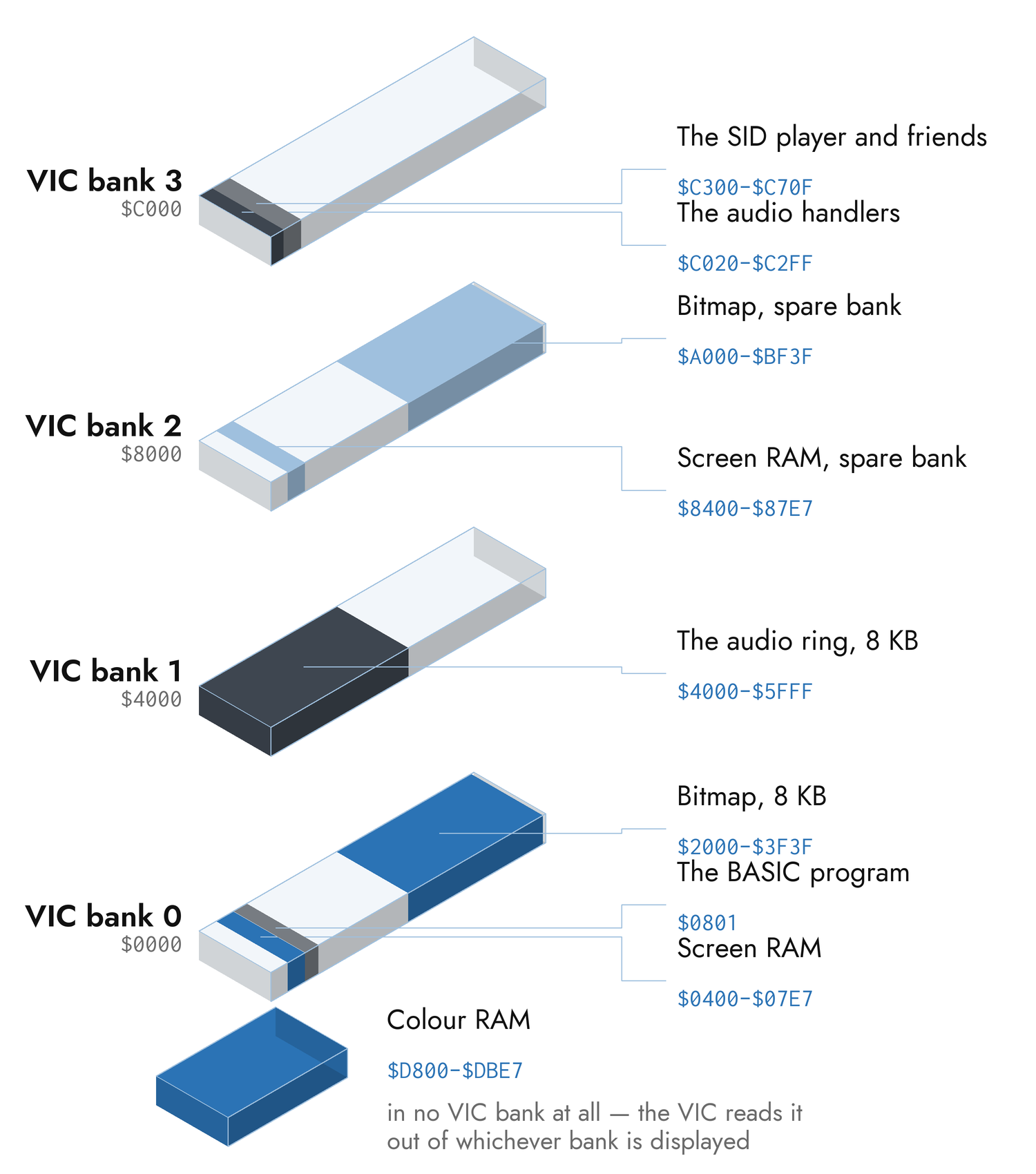
The Picture#
| Address | Contents |
|---|---|
$0400-$07E7 |
Screen RAM, VIC bank 0 |
$2000-$3F3F |
Bitmap, VIC bank 0 |
$8400-$87E7 |
Screen RAM, VIC bank 2 — double-buffered paths only |
$A000-$BF3F |
Bitmap, VIC bank 2 — double-buffered paths only |
$D800-$DBE7 |
Color RAM |
Character modes use screen and color RAM. Bitmap modes use the bitmap plus screen RAM, where hires packs its two per-cell colors into that byte's two nibbles; multicolor bitmap adds color RAM for its third.
Color RAM is not part of a VIC bank. There is one of it, and the VIC reads it whichever bank is displayed — which is the one asymmetry in the double-buffered paths, and the reason a multicolor bitmap's third per-cell color can still tear across a bank swap while the picture itself does not.
Sound#
| Address | Contents |
|---|---|
$4000-$5FFF |
The 8 KB audio ring the interrupt reads from |
$C020 |
The interrupt handler that writes $D418 |
$C100 |
The expansion-memory pump handler |
$C200-$C204 |
Its five-byte tracker: the expansion-memory read position (three bytes), then the ring write position (two) |
$C205 |
The pump's tick counter |
The ring lives at $4000 — VIC bank 1 — deliberately. Banks 0 and 2 are the ones the display paths use, and are also the two banks where the character ROM is shadowed; the 6510 sees $4000 as ordinary RAM whatever the VIC is doing. A bitmap mode wanting bank 1 for itself would have to move the ring. Nothing does today.
The SID Player and Friends#
| Address | Contents |
|---|---|
$0801 |
The one-line BASIC program that starts the player |
$C300 |
The SID player, by default |
$C400 |
Its re-INIT stub, by default |
$C500 |
The bank-swap interrupt handler |
$C700-$C70F |
The frame tracker that handler reads |
$C000-$C2FF belongs to audio and to big_text, whose raster interrupt handler and two shadow registers fill $C000-$C01F on a blank scene. That is why the player starts at $C300 and why the relocator refuses any layout that would overlap the range. A tune whose payload covers $C300 moves the player into the largest clear hole instead.
The frame tracker is sixteen bytes packed contiguously so the host can stage a whole frame's parameters in one write. The wire's ordering then guarantees the interrupt sees either all of the new values or all of the old ones, never a fresh ready flag paired with half-written registers.
Expansion Memory#
The REU is used as staging: the host writes into it without touching the Commodore's bus at all, and one transfer moves the bytes into main memory.
| Offset | Contents |
|---|---|
$000000 |
A video scene's pre-encoded soundtrack |
$100000 |
The 64 KB microphone ring |
$200000 |
The 1 MiB sampler ring |
$300000 |
The ASID ring player's frame slots |
$E00000 |
Character-mode screen staging |
$E10000 |
Bitmap, screen and color staging |
c64cast provisions the REU at 16 MB for a run that needs one and puts the original settings back at teardown. Those changes are live and never written to flash, so a power cycle reverts them even if teardown is missed.
The BASIC Program Underneath#
After the reset that starts a session, c64cast runs a 25-byte BASIC program: clear the screen, then loop forever. It is doing two jobs. Clearing removes the READY. banner. Looping keeps BASIC busy, and so out of the editor's direct-input mode — the only thing that re-arms the cursor blink — which is why no cursor ever appears over the picture.
It also keeps running underneath every scene. The display writes overwrite screen and VIC memory, never the BASIC program, so the kernal's interrupt keeps scanning the keyboard the whole time. That is what makes the C= / CTRL / SHIFT keys work during a scene at all — and it is why the TeensyROM's paused state clears the screen rather than resetting. A reset there lands at the cartridge's own menu, whose input handling does not run the kernal scan, and the resume key would never be seen.
The Character ROM#
Every C64-native glyph c64cast draws — the text overlays folded into a bitmap, the scroller, the oscilloscope's labels, the on-C64 menu, and the preview and recording renderers — comes from the character ROM.
The ROM cannot be fetched from the host. Reading $D000 returns the I/O page, because what is mapped there is decided on the Commodore, at read time. So c64cast runs a stub on the machine that unmaps I/O, copies the 4 KB down into plain RAM, and puts the banking back; the host then reads the copy. That happens once, on the first run against a given machine, and the result is cached under the data directory.
The copy is verified structurally rather than against a known image — a Swedish machine's charset, or a JiffyDOS font, is exactly the charset that user wants. What is checked is that it is a charset: two full sets, the upper half complementing the lower, screen code $20 blank and $01 not. A file that fails is not written, because an unverified one is worse than none and would suppress the automatic dump forever.
With no ROM resolved, glyphs fall back to a rendered ASCII font. It is legible, it is not the C64 font, and PETSCII graphics characters come out blank — which is the whole explanation for a scroller that "looks wrong". --doctor reports which ROM is in use.
No ROM bytes enter the repository, the wheel, or a release. They move from your hardware to your disk and stop there.
Regions and the Dirty Model#
Sending 8000 bytes of bitmap sixty times a second is 480 KB/s of writes over a link that carries about 200 commands a second. Two mechanisms make that arithmetic work.
Coalescing. Contiguous register writes go out as one command: the border and three background registers are four addresses and one write.
The dirty cache. Every buffer upload goes through a call that remembers what it last sent for that region and transmits only the sub-range that changed. A static character-mode scene therefore writes almost nothing after its first frame, which is why those modes hold the full system rate where a bitmap cannot. Past a threshold — more than 60 % of the region differing — it abandons the diff and sends the whole buffer, since one large write beats several scattered ones.
The cache is keyed by region, not by address. A region is a small integer naming a logical buffer: the screen, color RAM, the bitmap, one voice's strip of the oscilloscope, one row of the on-C64 menu, and — importantly — bank 2's bitmap and screen separately from bank 0's. Keying by address would be wrong in two ways at once. A mode switch from PETSCII to multicolor text writes different meanings to the same $0400, and a double-buffered path writes two alternating banks that must each diff against their own previous content rather than against each other's.
A display mode invalidates the cache when it sets up, so a mode switch starts from a clean baseline instead of diffing new bytes against the previous mode's reading of the same addresses.
The cache also empties itself whenever a write may not have arrived: a write that failed, or, on an Ultimate, a dropped DMA connection that still had writes the machine had not confirmed. The next frame then resends every region in full, so a still picture that lost part of a frame repaints instead of staying wrong until that part changes. The Ultimate is checked for a dropped connection on every upload, even one that sends nothing.
Why Cuts Do Not Tear#
Writing 8000 bytes takes long enough that the VIC will draw part of the old frame and part of the new one. Both fixes give the machine two banks and flip between them.
REU staging writes the frame into expansion memory — which touches no bus — and a raster interrupt at the start of vblank then triggers the transfers into the off-screen bank and flips $DD00. The flip is a single store and lands inside vblank, so the swap is invisible.
Host-DMA double-buffering does the same page flip without needing an REU: the host writes the off-screen bank directly, then arms a three-byte tracker, and the interrupt does nothing but change two registers.
They are mutually exclusive — both flip the same register — and "auto" chooses between them. REU staging wins on a machine that has one, except for a bitmap scene carrying a text overlay: the transfers inside that interrupt run long enough to push the flip past vblank into the visible rows, and fine glyphs in the bottom rows shimmer. Those scenes take the host-DMA page flip instead, whose interrupt does no transfers at all and therefore always lands in time. Character modes stay on plain writes under "auto", because their dirty cache makes a full per-frame transfer a regression.
Any uncertainty — no REU, a failed query, --skip-probe, a backend without one — degrades to plain writes, so video never silently freezes.
The Write Budget#
A frame's cost is the number of write commands it takes, not the number of bytes, and the ceiling is roughly 200 commands a second.
| Scene | What a frame costs |
|---|---|
| Character mode, static content | Almost nothing; the cache absorbs it |
| Character mode, live video | Two regions, mostly partial |
| Hires bitmap | 8000 bytes of bitmap plus 1000 of screen |
| Multicolor bitmap | The same, plus 1000 of color RAM |
| Oscilloscope, scrolling | The strips rewritten every frame, ≈700 KB/s |
That arithmetic is where the default frame-rate caps in Chapter 2 come from. A bitmap scene streaming digitized audio is the heaviest case in the program, and 20 fps is where it fits.
--profile prints what is actually happening, per scene, every ten seconds. It comes out as one long line per scene; it is broken at its separators here, and indented, so that it fits the page:
profile[webcam:mcm] n=58 |
    frame avg=33.4 p50=33.3 p95=34.1 max=41.2 ms |
    cpu_render avg=12.8 ... |
    compose avg=5.4 ... |
    push avg=7.0 ... |
    wait avg=20.5 ... |
    writes/frame avg=24 p95=27 |
    bytes/frame avg=8192 p95=8192
u64 dma latency: n=256 avg=5.1 p50=4.9 p95=7.8 max=18.4 ms
    reconnects=0
frame is wall-clock per frame and should sit near 1 / target_fps at steady state. wait is time asleep waiting for the next deadline — a healthy scene has plenty of it. compose is host-side quantization and push is the link. When wait approaches zero and push dominates, you are out of budget on the wire; when compose dominates, you are out of it on the CPU, and the two have different answers.
When a frame runs late the playlist advances its deadline and drops the missed frames rather than bursting to catch up. Animation reads wall-clock time, so a dropped frame costs smoothness and never position.
What to Give Up First#
In order of what they buy against what they cost:
- The display mode. A character mode is an eighth of a bitmap's traffic. This is by far the largest lever, and it is not a downgrade — for many audiences PETSCII is the point.
target_fps. Halving it halves everything.- The dither method. The error-diffusion methods are per-pixel loops; the
ordered family is one vectorized operation. That is a
composecost, not apushcost. cell_strategy.error-minscores twenty color trios per cell — excellent for a slideshow, unnecessary for motion.- Overlays. Each composes into the frame, and a marquee changes cells every frame, which keeps its region permanently dirty.
What not to give up: coalescing and the dirty cache are automatic, and any new code path that issues many small writes per frame is the first thing to look at.