Chapter 4
Sound
The Commodore was never designed to play recorded audio. It has a three-voice synthesizer and, on the Ultimate, a modern FPGA that can play PCM from expansion memory; between those two facts sits everything c64cast does with sound. This chapter is the sound path in both directions — a decoded soundtrack going out, a SID tune playing on the real chip, and a microphone coming back in to drive the picture.
The settings are [audio], [dsp] and [audio_features] in Appendix A, and the SID-related keys of [ultimate64] in the same place.
Two Ways Out#
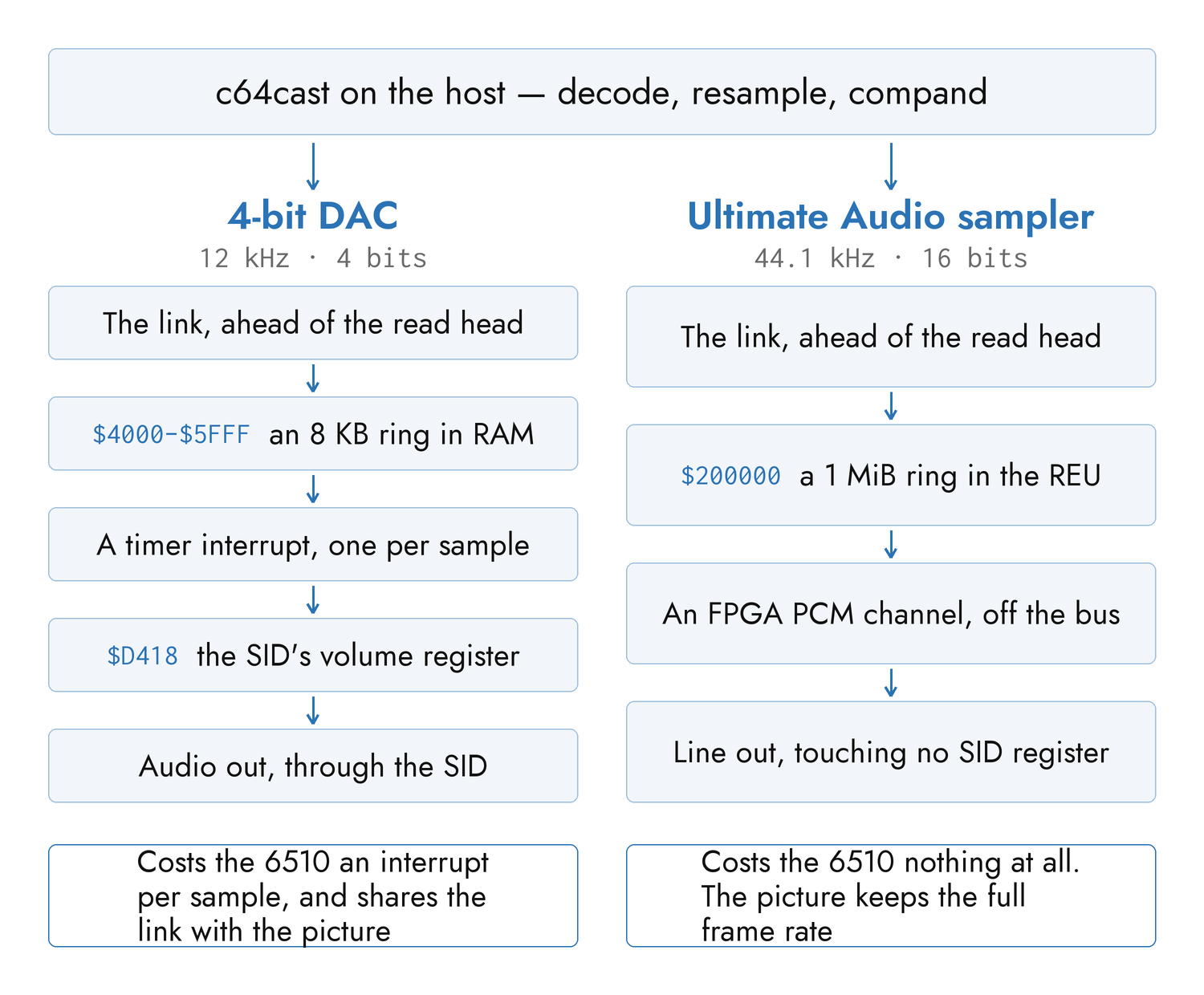
There are two ways to get non-SID audio out of the machine, and which one you get is the single most audible choice in the program.
| 4-bit DAC | Ultimate Audio sampler | |
|---|---|---|
| Where it plays | The SID's $D418 volume register |
An FPGA PCM channel, off the bus |
| Resolution | 4 bits, or ≈6–7 effective with a companding curve | 8 or 16 bits |
| Rate | 12 kHz by default | 44.1 kHz by default |
| Costs the 6510 | An interrupt per sample | Nothing at all |
| Available on | Everything | The Ultimate 64 / Ultimate II+ |
[audio].backend chooses: "auto" takes the sampler where the machine has one and the DAC everywhere else, and "dac" forces the lo-fi path. Microphone and webcam audio always take the DAC, on every machine.
The 4-Bit DAC#
The SID's master volume register is four bits wide. Write a sample value into it fast enough and the chip's output level tracks the signal — this is the digi trick C64 musicians have used since the 1980s, and it is the only method that works on a real machine with the video still running.
An interrupt fires at the sample rate and writes one byte from a ring buffer in the Commodore's memory; the host keeps that ring topped up over the link. The interrupt is driven by a hardware timer that counts whole processor cycles, so the achievable rates are a grid rather than a continuum: sample_rate is a request, and what you get is the nearest point on that grid. At the 12 kHz default on NTSC the real rate is 12032 Hz — a shift of 0.27 %, or 4.6 cents against a 50-cent quarter tone. It is the achieved rate, not the requested one, that everything downstream uses as its timebase, so nothing drifts against it and a decoded track plays at exactly real time.
12 kHz is the default because the interrupt handler cannot be serviced indefinitely faster. The handler itself runs out of time near 13.5 kHz, and the full streaming pipeline — where the host's own memory writes steal processor cycles — starts overrunning near 12.5 kHz. Above that, handlers queue behind each other and samples stretch: the tone goes flat. Rates that overrun are rejected when the configuration loads, and --doctor reports them.
A TeensyROM+ has no sampler and is therefore always on this path. In the cartridge port of a C64U or an Ultimate 64 it also needs that machine's own F2 → Cartridge and ROM Settings → Bus Operation Mode set to Writes (or Dyn. & Writes) rather than its Quiet default, saved in the Ultimate's settings. Ultimate 64 firmware 3.15 adds Compatibility, which includes writes; Writes remains the tested setting. On Quiet the stream can carry a constant hiss that no shaping in the next section touches. c64cast cannot set it during a run, because the run's connection is to the TeensyROM+ and not to the Ultimate.
The Ultimate Audio Sampler#
The Ultimate's FPGA carries a PCM sampler that plays straight out of REU memory. It touches no SID register, fires no interrupt, and costs the 6510 nothing, so it is immune to every problem in the section above and sounds like the source rather than like 1987.
c64cast programs one channel as a loop over a 1 MiB ring in expansion memory and writes decoded audio ahead of a read head it computes from the wall clock. There is no feedback loop — the read position is never read back, because it cannot be — so the whole path depends on knowing the FPGA's real sample rate. That is what [audio].sampler_clock_hz is for; see "Keeping Sound and Picture Together" below.
sampler_sample_rate and sampler_bits set the format, defaulting to 44100 and 16. An explicit backend = "sampler" on a machine that has none warns and falls back to the DAC.
The sampler needs the REU enabled and the FPGA sampler mapped. c64cast turns both on for the run and puts them back at teardown; the changes are live and never written to the machine's flash, so a power cycle undoes them regardless.
Its two mixer channels, Vol Sampler L and R, are relative to the machine's Vol Master on Ultimate firmware 3.15 and newer, which scales every source at once. A run that wants audio lifts Vol Master from OFF to 0 dB the same way and puts it back afterward; any other master level is left as it is. Firmware without the setting (3.14 and earlier, and the C64 Ultimate's 1.1.0) behaves as if it were at 0 dB.
What Each Costs in Frame Rate#
Audio on the DAC competes with the picture for the same link and the same processor, so a scene streaming digitized audio caps its frame rate. Audio on the sampler does not, and video keeps the full system rate. That table is in Chapter 2 under "Frame Rate", and it is the main practical reason the sampler is the default on the Ultimate.
The exception is a generative scene playing an audio file through the sampler, which stays at half system rate: a generator draws a genuinely new frame every tick where a video decoder repeats them, and 60 real bitmap frames a second starves the sampler's own writes to expansion memory.
Shaping the Signal#
Four bits is about 24 dB of range. A signal that uses all of it sounds present; one that does not collapses into a handful of levels and buzzes. So everything on the DAC path runs through a host-side processing chain first, in this order:
Pre-emphasis lifts the high frequencies, so consonants survive a 6 kHz ceiling. AGC — microphone input only — corrects gross level. The expander cleans the noise floor before anything raises it, with hysteresis rather than a hard gate, so a signal hovering at the threshold does not chatter. The compressor evens out what is left and applies makeup gain. The limiter is the ceiling.
The order is load-bearing, and [dsp].enabled = false bypasses the whole chain exactly. It applies to the $D418 path only: the sampler is 16 bits and needs none of it.
Companding — dac_curve#
The classic path maps a sample to one of the sixteen volume levels and stops there. dac_curve opens a better one.
In a particular SID setup — all three voices parked as steady DC sources, two of them routed through the analog filter — the whole $D418 byte becomes audible, not just the volume nibble: the filter-mode bits and the voice-3-off bit each shift the output level as well. The 256 values then select 256 distinct, strongly non-linear levels, worth about six to seven effective bits. The cost is unchanged — still one write per sample — and only the values in the ring differ.
dac_curve |
Meaning |
|---|---|
"auto" |
The default. A calibration measured from the SID answering $D400 if one exists (except one whose chip the calibration identified as an ARMSID or ARM2SID, which gets "linear"; a TeensyROM+ cannot identify the chip, so its tables are not excepted), else the built-in table when an UltiSID core owns that address, else "linear" — so an uncalibrated socketed chip gets the plain 4-bit path, not a table measured on different silicon |
"linear" |
The plain 4-bit path |
"mahoney_ultisid" |
The built-in table, measured from the Ultimate's own emulated SID |
"calibrated" |
Force the measured table; an error if there is none |
The built-in table generalizes across Ultimates because their SID is an FPGA core and deterministic. Physical chips do not generalize at all — two 6581s measured on the same rig correlated only 0.74, and swapping their tables cost 29 % in level error. So a socketed chip wants its own measurement:
c64cast -u u64://192.168.2.64 --calibrate-dacThat plays a ladder of levels through the chip, records the result through a capture device, and writes a table. The capture device is the audio input --audio-device names, by index or name. Without that flag, it is the one audio input named like the connected HDMI capture device; finding that device needs the camera extra. If no input can be found that way (no extra, no capture device or several, or no input or several with its name), the run stops before it touches the machine, lists the inputs, and asks for --audio-device. It never records from the system default input, which on most computers is the microphone. It takes about fifty seconds per SID socket, and a machine with two socketed chips measures each one separately. The file is keyed to the machine's own identity — the Ultimate's serial number, a TeensyROM's USB serial — so a changed address does not orphan it. [audio].dac_calibration_profile overrides that key with a name of your own, or — given a path — points a run at another machine's calibration file outright, which is how a table measured over the Ultimate replays the same chip over a TeensyROM+ in that machine's cartridge port.
The measurement is checked before it is kept. Sixteen of the 256 values set the master volume to zero and must therefore be silent whatever else they say, each level is the median of several passes so a single glitched reading is discarded outright, and a capture whose passes disagree broadly is refused — the message says whether the level was still settling or the laps genuinely played different levels, which have opposite fixes — because a bad calibration is worse than none. A refused capture is kept under calibration/unusable/ in the data directory, with its diagnostics, so the evidence survives the refusal. On the one chip where both were compared, the measured table beat the plain 4-bit path by 1.7 dB while running 5.9 dB louder.
Two more knobs sit here. [audio].dither adds a little triangular noise during encoding; it is off by default because at four bits the hiss it adds costs more than the distortion it removes, and it is worth trying only on already-noisy material. [audio].digi_boost parks the three voices to raise the output level — mandatory on an 8580 by the classic literature, worth about three times the level on a real 6581, and marked experimental because it has not been tried on enough hardware.
Keeping Sound and Picture Together#
Audio is the master clock. A video scene chooses each frame against the audio position rather than against a timer, so the two cannot drift apart over a long clip however irregularly frames arrive. Everything in this section is about making that audio position true.
The Sampler's Clock#
The sampler's design rate base is 6.25 MHz, and the U64's FPGA clocks it about 1.44 % slow. Since video is paced by the host's clock while audio clocks out of the FPGA, that gap slides the sound behind the picture by seconds over a few minutes — the beep drifting off the flash, worsening toward the end.
Nothing on the host can detect this: comparing the observed rate against the assumed one agrees by construction, and there is no read-back to check against. So the real figure is measured once and shipped as the default, [audio].sampler_clock_hz = 6160000. It is a property of the firmware's clock derivation rather than of an individual unit, so every U64 on the same firmware wants the same value, and at that setting a five-second interval drifts by 1.3 ms. Ultimate 64 firmware 3.15a (FPGA 125, core 1.50) re-measured at the same value, with a drift of 1.2 to 1.5 ms per five seconds. Hardware that clocks the sampler correctly can set 6250000.
The Bitmap-and-DAC Time Stretch#
Forcing the DAC path under a bitmap display mode makes everything play about 12 % slow, at correct pitch. The audio worker shares one link with heavy bitmap writes; under that load it is throttled, the ring under-fills, and the interrupt re-reads samples — which stretches time without changing pitch. Video, slaved to the audio clock, follows it down.
The fix is to pre-compress the content by the inverse factor so the system's own stretch nets back to real time. [audio].dac_bitmap_tempo_mhires and dac_bitmap_tempo_hires hold the observed speed fractions. Left unset, they take the values measured for the connected hardware: 0.88 and 0.89 on an NTSC Ultimate 64-II and on a TeensyROM writing unsliced (the default), 0.97 on a TeensyROM+ whose [teensyrom].dma_slicing is turned on and whose firmware slices its DMA writes. They apply only to the DAC backend under a bitmap mode; the sampler, the character modes and a muted scene all pass through untouched. Other platforms differ — measure yours and set the field.
The Pitch Knobs That Default Off#
Three settings correct the DAC path's pacing, and two of them are off.
[audio].host_dma_servo is on: it watches the gap between where the host is writing and where the interrupt is reading, and stretches the worker's pace to keep that gap near half a ring. It is orthogonal to pitch and should stay on.
nmi_rate_adaptive and the pitch_mult_* multipliers both push the interrupt rate back up to compensate for stolen cycles, and there are no longer any stolen cycles to compensate for: with the frame-rate caps and the staged double-buffer in play, uncompensated mhires video on the DAC measures within 0.1 % of correct. Enabling either one only injects error — a static multiplier of 1.015 overcorrects to +1.36 %, and the adaptive loop, whose estimator reads about 12 % high, has driven a clip 8.5 % slow. They remain for platforms that may still lose cycles, and they remain off.
Playing SID Tunes#
A waveform scene, and a generative scene with audio_source = "sid", do not stream audio at all. The tune is written into the Commodore's memory along with a small player program, and the Commodore plays it on its own chip. That is why a SID scene sounds exactly like the hardware: it is the hardware.
The Player#
The player is a hand-written 73-byte 6502 program, with a 35-byte re-INIT stub beside it for subtune changes. By default they sit at $C300 and $C400; a tune whose payload would overlap moves them into the largest clear hole in memory. Started, the player calls the tune's INIT once, installs its PLAY routine on the interrupt vector, and then spins forever rather than returning — INIT routinely destroys BASIC's zero-page state, so a return would print a syntax error. The interrupt handler chains to the kernal's, which keeps the keyboard scan alive and the cursor from blinking.
The player switches the memory banking around each call into the tune and puts it back afterwards. That is not caution: tunes whose entry points sit under BASIC ROM need it banked out to run at all, and tunes that read BASIC ROM as data need it mapped back between calls, and tunes that assume the resting configuration crash without the restore.
The firmware's own SID-player endpoint is deliberately not used. It draws its own player interface on the HDMI output, over everything c64cast paints.
What Is Refused#
PSID files only, and four kinds of PSID are refused at setup with an explanation:
| Refused | Because |
|---|---|
| RSID | It installs its own interrupt in INIT |
load_addr below $0820 |
It would land on the BASIC stub that starts the player |
A zero play_addr |
INIT installs its own interrupt |
Code under KERNAL ROM ($E000-$FFFF) |
The player cannot bank the kernal out without losing the interrupt chain it needs |
A waveform scene additionally refuses a tune that would load low enough to overwrite the oscilloscope's bitmap. When the scene's file is a directory or a glob, a refused candidate is skipped and another drawn, so a folder of mixed tunes still plays.
Tempo, Pitch, and the Machine's Standard#
A tune composed for a PAL machine has two ways of coming out wrong on an NTSC one, and they are separate problems with separate fixes.
Tempo. The player chains PLAY onto the kernal's interrupt, and the kernal runs that interrupt at about 60 Hz on both standards — it is a clock service, counting toward the jiffy timer and the keyboard scan, not something tied to the video frame. A PAL tune expects to be called 50.12 times a second, so played this way it runs nearly twenty percent fast, on a PAL machine as much as an NTSC one.
[ultimate64].sid_play_rate decides what to do:
| Value | Effect |
|---|---|
"auto" (default) |
PLAY at the tune's own frame rate, from its header's clock flag |
"off" |
Leave the kernal rate alone — every vsync tune plays at ~60 Hz |
| a number | Pin every vsync tune to that rate in Hz |
"off" is the behavior that predates the setting, and it is a legitimate preference: a great many people know these tunes at the speed an NTSC machine played them. An explicit number is the same choice made deliberately — 59.826 is the NTSC frame rate, 50.125 is PAL.
A multispeed tune programs its own timer from INIT and is never overridden. c64cast checks two things before touching the rate: the header's per-subtune speed flag has to say the tune expects one call per frame, and the timer value actually in place after INIT has to look like the kernal's rather than a multispeed one. The second check is what protects tunes whose header lies.
The correction is also dropped, with a note in the log, when [audio].use_reu_pump is on — that path programs the same timer for its own purposes and there is only one of it.
Pitch. The processor clock is 985 248 Hz on PAL and 1 022 727 Hz on NTSC. Everything the SID produces scales with it, so a PAL tune on an NTSC-timed machine is sharp by 3.8%, about two thirds of a semitone, whatever the PLAY rate is. The only fix is to retime the machine.
On an Ultimate 64 that is its System Mode setting, and [ultimate64].sid_video_mode = "auto" will switch it to match [ultimate64].system for the run — live, never written to flash, and restored when the run ends. It is off by default because the HDMI output mode changes with it, from 480p60 to 576p50, and every display and capture device on the other end has to re-lock. Some capture devices do not manage 576p50 at all; [ultimate64].hdmi_scan_resolution exists to raise the Ultimate's upscaler to 720p when that happens, and its "auto" default does so whenever c64cast is the thing that retimed the machine.
If a video mode ever leaves you looking at nothing, hold C= and P or C= and N while the Ultimate boots to force it back to PAL or NTSC.
One asymmetry worth knowing before you turn it on: over HDMI, retiming costs you a re-lock and nothing else, because the Ultimate's upscaler emits RGB and the standard's color encoding never reaches the cable. Over composite it costs more. c64cast keeps the color encoding the machine was set for, so a television that decoded color still can, but the field rate changes underneath it — and a television built for one standard may not lock to the other's rate at all. A PAL machine retimed to NTSC emits PAL color at 60 Hz, which most multi-standard sets tolerate; an NTSC machine retimed to PAL emits NTSC color at 50 Hz, which is rarer and more often comes out monochrome. Audio is unaffected either way, apart from the pitch change you asked for.
How the Oscilloscope Knows#
The SID is write-only. Reading $D400-$D418 returns nothing useful, so c64cast cannot ask the chip what it is doing. Instead it runs the same tune a second time, on a host-side 6502 emulator, and watches the register writes that emulator makes. The picture is drawn from those.
What that buys is a per-voice trace at the right frequency, waveform and envelope, costing no traffic on the link at all. What it does not buy is phase accuracy against the audio: the two are running the same code from the same start, not sharing a clock. It is an oscilloscope of the music, not of the output.
Multi-SID tunes are detected from the header (and from an HVSC-style filename when the header understates the count), and each chip gets its own emulator and its own column in each voice row.
Duration and Subtunes#
Playback gives no end-of-tune signal, so a scene normally ends when its timer does. Set [playlist].songlengths_file to an HVSC song-length database and every tune gets its real length automatically; without one, a tune with no explicit duration_s runs for three minutes.
The one thing that can end a tune sooner is silence: once the tune has sounded at least once, six seconds with every voice silent ends the scene and the playlist moves on, rather than holding a frozen flat trace for the rest of the timer. A musical rest is nowhere near long enough to trip it.
SHIFT advances to the next subtune, rebuilding the emulator and re-resolving the duration. A subtune that the emulator cannot run at all — one that spins waiting for an interrupt the player never provides — ends the scene with an error in the log instead of being cued, because playing it would leave the C64 silent and unresponsive. With a song-length database loaded, subtunes shorter than five seconds are skipped while cycling — most of those are a game's sound effects, and the scope of a sound effect is a flat line. A subtune you asked for explicitly, or the file's own start song, always plays however short it is.
Matching the Chip to the Tune#
A PSID header says which SID model it was written for, and the two models sound substantially different. [ultimate64].sid_model decides what to do about that:
| Value | Behavior |
|---|---|
"auto" |
The default. Read the header, per chip, and route each chip to hardware that matches |
"6581" / "8580" |
Force that model for every chip, ignoring the header |
"off" |
Do not inspect the header at all |
Matching is not transmutation. A socketed 6581 is a 6581; what autoconfig can do is notice that the other socket holds the model the tune asked for and remap the addresses, or fall back to one of the Ultimate's emulated SID cores and set that core's filter curve to the requested model. If neither is possible it warns and plays anyway.
For a multi-SID tune, routing and model matching happen in one pass, because they cannot be separated: a router that places chips without regard to model, followed by a corrector that moves them, will take away a core the router had already given to another chip and leave it silent.
On an Ultimate II+ the same setting means something simpler. That machine has no SID sockets and no cores to fall back to — its audio jack is fed by two SID emulations, each listening at an address you choose. There is no other chip to go looking for: the side already playing your tune's chip is just told which model to be, and it becomes one. Nothing gets displaced and nothing can fail for want of matching hardware.
One chip is beyond reach there. The tune is also playing on whatever SID the host C64 itself carries, out that machine's own audio jack, and no setting changes the model of the chip in the machine. If the tune asked for the model your machine doesn't have, the log says so on both routes at once — the emulations matched, the host chip not.
The two routes are also two cables. The emulated SIDs are heard on the Ultimate II+'s own green audio jack; the C64's AV output carries the real chip. Judging a model change by ear through a monitor therefore proves nothing — that is the route the change cannot reach. An Ultimate 64 has no such split.
Declaring the Host Chip#
The internal SID is the one thing c64cast cannot read. [hardware].host_sid_model supplies it:
| Value | Behavior |
|---|---|
"auto" |
The default. Assume NTSC → 6581, PAL → 8580, and warn once per run that this is a guess |
"6581" / "8580" |
Declare the chip as fact; no warning |
"unknown" |
Make no assumption and pass no verdict on that chip |
The warning is deliberate rather than incidental. The NTSC/PAL convention is a weak rule — NTSC machines carrying an 8580 are common — and every model verdict on a route whose chip cannot be read is only as sound as that guess, so the guess announces itself once and then stops. Declaring the field silences it permanently. There is no CLI flag; it belongs in the machine settings file.
Machines With More Than One Internal SID#
host_sid_model names one chip, which is one too few for a C64 carrying an internal dual-SID mod (ARM2SID, SIDFX, DualSID). Those answer at a second address in the machine's own hardware — commonly $D420 or $D500 — and frequently at a different model from the first, which is much of the point of fitting one. [hardware].host_sid_chips declares them per chip:
[hardware]
host_sid_chips = { d400 = "6581", d420 = "8580" }
Keys are hex addresses on a $10 boundary in $D000-$DFF0, with or without a leading $; values are 6581, 8580, or unknown (the chip exists, its model is not known — reported, but no verdict passed on it). Bad keys and values are rejected at load, because a typo would otherwise surface as a chip quietly missing from the resolved-audio line.
When set, this supersedes host_sid_model entirely: the machine is described, so the NTSC/PAL convention has nothing to infer and its once-per-run warning does not fire. Declare every chip, $D400 included. Each of the tune's chips is then rendered against whatever is declared at its address, and a tune address with no declared chip is reported as such rather than omitted.
No routing is involved anywhere in this. A multi-SID tune on such a machine plays on both chips because the tune writes to both addresses and the chips are already there — the mod has done in silicon what a U64 does in configuration. The declaration affects what c64cast says, and — through host_sid_tune_match below — which tune a directory pool picks. It never changes a chip.
All of this is best-effort and restored at teardown. Model matching is Ultimate-only — on a backend with no configuration interface there is no hardware to reconfigure, so the declarations feed the verdict alone and the tune plays on whatever the machine actually carries.
When a Tune Wants More Chips Than the Machine Has#
On a link with no routing surface, a tune driving chips past $D400 needs the machine to have them already. Chip 0 is never in question — every C64 has a SID at $D400 — so the check is on the rest: a tune address with no host_sid_chips entry gets a warning, once per run, naming the address and both readings of it (a mistaken tune pick, or an undeclared mod).
The warning depends on no declaration at all, which is the point of it. A partly-declared machine already gets $D420 → no chip declared in its verdict, but the default configuration declares nothing, and that is the state a mistakenly-picked _2SID.sid is likeliest to arrive in. Warning from "this machine has one SID" is safe precisely because the alternative is hardware somebody chose to install.
What each configuration produces for a two-chip tune:
| Link | [hardware] declares |
Result |
|---|---|---|
| U64 | anything | Chips are routed per tune; no warning applies |
| U2+ / TR+ | nothing | WARNING naming $D420; no verdict line (nothing to render) |
| U2+ / TR+ | host_sid_model only |
WARNING naming $D420; verdict covers $D400 only |
| U2+ / TR+ | host_sid_chips without $D420 |
WARNING naming $D420; verdict adds $D420 → no chip declared |
| U2+ / TR+ | host_sid_chips with $D420 |
No warning; per-chip verdict for both |
Two details in the wording. On a U2+ the emulated SIDs do play the tune as authored, so the warning there points at the Ultimate's own jack rather than claiming the tune is broken — and it replaces the two-outputs warning from "Matching the Chip to the Tune" for that tune, which attributes the AV output's problem to the chip model and would be the wrong diagnosis here. A later model-mismatched tune still gets that warning normally. And a second chip mapped outside $D400–$D7FF is described as making no sound rather than collapsing, because cartridge I/O is not SID space and nothing answers there at all.
Picking Tunes the Machine Can Play#
The declarations above answer "what does this machine carry?". On a link that cannot re-place chips, a tune the machine does not suit stays that way — the chip is what it is. [hardware].host_sid_tune_match acts on the one variable that is free: which tune a multi-file waveform pool picks.
| Value | Behavior |
|---|---|
off (default) |
The pool is untouched. |
prefer |
Fitting tunes are tried first; the rest remain as a fallback tail. |
require |
Non-fitting tunes are dropped from the pool. |
A tune fits when the declarations would produce a clean resolved-audio verdict for it: the right model on every chip, and a chip declared at every address the tune drives. The check runs through the same renderers as that verdict rather than re-deriving the match, so a pick and the line logged moments later cannot disagree. Only the PSID header of each candidate is read, so ordering a large directory costs a few hundred short reads, not a full load per tune.
Three cases are deliberately no-ops, and in each the pool is left exactly as it was:
- A link that reads the real SID state (the U64 multi-SID surface). It re-places chips per tune, so no tune is a poor fit to begin with.
- An assumed host model.
host_sid_model = "auto"resolves through the NTSC/PAL convention, and that is too weak a basis for dropping tunes out of someone's directory. The verdict may warn on a guess; selection will not act on one. Declaring the model — or the chips — turns the feature on. - Nothing declared at all (
host_sid_model = "unknown", nohost_sid_chips).
What each declaration buys differs. host_sid_chips describes the whole machine, so a tune driving an address it does not list fails the check — that is what skips 2SID tunes on a single-SID machine. host_sid_model alone judges the primary chip's model only: it names a chip without claiming it is the only one, and inferring a chip count from it would reject working tunes on a machine whose second chip c64cast was simply never told about.
require still falls back to the full pool, with a WARNING, when nothing fits. A mis-declared machine — or a directory of tunes for a model the user does not have — is a configuration mistake, and degrading to the unfiltered pool surfaces it as a line in the log instead of a scene that can never start.
Setting [ultimate64].sid_model to 6581 or 8580 makes that the model every chip must match, and off disables model matching entirely, leaving only the address check. This is the same required_models_for resolution the verdict uses.
Placing and Balancing Voices#
The Ultimate mixes each audio source — physical socket 1, socket 2, and the two emulated cores — at its own level and its own place in the stereo image. Two settings drive that mixer, and both are indexed by source rather than by chip: entry k addresses the k-th source the tune claims. Through four chips the two coincide.
sid_panning#
[ultimate64].sid_panning spreads a tune's chips across the stereo field. Each entry is an integer from −5 to 5, or the equivalent label. An empty list takes the default spread:
| Chips | Spread |
|---|---|
| 1 | Center |
| 2 | Left 3, Right 3 |
| 3 | Center, Left 3, Right 3 |
| 4 | Left 2, Right 2, Left 5, Right 5 |
Those are ordered by musical importance rather than as a uniform fan: with an odd count the primary chip sits dead center and the others flank it. The oscilloscope's columns follow the pans rather than the chip order, so a three-chip tune reads left to right on screen exactly as it sounds.
There is one refusal. When chips outnumber the machine's available sources — a three-chip tune with no usable socket, so all three land on two cores — the spread would throw two chips hard left against one hard right, which misrepresents the tune. The default collapses to center instead. An explicit sid_panning still does whatever you ask.
sid_volume#
This exists because of a specific silent failure. The Ultimate ships with the two emulated cores' levels set to OFF, and routing a chip onto a core — which multi-SID routing and model matching both do freely — then produces silence with no error anywhere: the chip is mapped, the player writes to it, and nothing comes out.
So the mixer is set deliberately, one source at a time:
| Source | Level |
|---|---|
In use, with a sid_volume entry |
That entry |
In use, currently OFF |
0 dB |
| In use, at some other level | Left alone — a rig trimmed to −6 dB meant it |
| Not in use | OFF |
Muting the unused sources is the other half of the fix: a core still mapped at an address the tune is using, with its level up, doubles the chip that is really there.
These levels are relative to the machine's Vol Master (Ultimate firmware 3.15 and newer), which sid_volume never sets. A run that wants audio lifts the master from OFF to 0 dB for its duration, as described under the sampler above.
Values are a dB integer, or a label. The hardware's ladder is not a uniform fan — OFF, then −42, −36, −30, −27, −24, then every step from −18 to +6 — so a level with no representation is rejected when the configuration loads rather than snapped to a neighbor.
Why a Spare Core Stays Mapped#
The Ultimate's LED display is driven by emulated-core activity, so a tune playing entirely on socketed chips lights nothing. Any core the plan does not need is therefore pointed at the socket's address instead of being unmapped — lit LEDs from the core, audio from the real chip — and muted, which is what stops it from being heard as well as seen.
ASID and MIDI#
Two scenes drive the real SID from somewhere else entirely. Both need the midi extra, and both draw the same oscilloscope as the waveform scene.
ASID#
ASID packs SID register writes into MIDI system-exclusive messages. An ASID host sends the stream and the asid scene receives it and plays it on the chip; Chapter 2's entry for that scene names the hosts and how to open a port for them. It is a new input, not a fidelity change: the protocol carries only what a SID can synthesize, never sampled audio.
There are two ways to play what arrives, chosen by asid_buffered_player.
The coalesced path keeps a shadow of each chip's registers and flushes a block write sixty times a second. It works everywhere and it is bounded by the link, which means a multispeed tune — one that plays several times per video frame — loses the frames between flushes, mangling arpeggios and hard restarts.
The buffered ring player moves frame consumption onto the Commodore. Each frame's register writes are serialized into a slot, written into a ring in expansion memory ahead of a computed read head, and popped one per tick by a handler the machine's own timer fires — reproducing the stream's own inter-write timing. Nothing is read back from the machine during playback. It needs an REU, so it is Ultimate-only; "auto" selects it whenever there is one. A two-times multispeed tune measured at exactly twice the coalesced path's modulation rate, which is the whole point.
Multi-SID streams are honored: extra chips are routed to their own addresses, preferring physical sockets, and the scope subdivides each voice row into one window per chip. asid_multi_sid and asid_max_sids gate and cap it. The FM-synthesis command is recognized and dropped, there being no OPL chip involved.
MIDI#
The midi scene turns the Commodore into a three-voice synthesizer. Notes set each voice's frequency and gate; pitch-bend moves gated voices by up to two semitones; velocity lands in the voice's sustain level.
Voice allocation layers a melody over a pad. Held notes keep their voice, and a new note over capacity steals the most recently started one — so the older, held notes form a stable pad while a line cycles on the top voice. Freeing a voice brings back the most recent note still held. Re-using a voice that is already sounding writes a gate-off before the new note, because the chip re-attacks only on a gate edge; without it the pitch changes and nothing is heard.
The controller map:
| CC | Target |
|---|---|
| 1 | Pulse width |
| 7 | Master volume |
| 71 | Resonance |
| 72 / 73 / 75 | Release / attack / decay |
| 74 | Filter cutoff |
The filter is audible because all three voices are routed through it; a cutoff that starts open means a lowpass patch is neutral until you sweep it.
In the default shared voice mode one MIDI channel spreads across all three voices. With multitimbral, midi_voice_channels routes channels to fixed voices, each monophonic with last-note priority, and notes on unmapped channels are ignored.
Listening Back#
Sound also comes in. With reactive = true, a generative scene reads a small feature snapshot each frame and moves with the music. Two producers fill it, and nothing downstream can tell which.
From a SID tune, the host-side emulator already knows each voice's envelope and frequency, so the features come free — no extra traffic, no analysis.
From audio, an analyzer runs over the incoming samples. It reports:
| Feature | What it is |
|---|---|
level |
Loudness relative to a rolling peak, so a quiet feed still reaches full scale and true silence reads zero |
onset |
A transient: a spectral-flux crossing against an adaptive threshold, latching to 1 and decaying |
bands |
Eight log-spaced bands, the same ranges the spectrum overlay draws |
bpm, beat_phase |
An estimated tempo and a continuously integrated phase |
[audio_features].onset_sensitivity is the one knob worth turning: dense, heavily compressed material reads as continuous transients at high values, and sparse material needs a push.
mic and listen#
The two differ in more than whether the Commodore makes a sound.
audio_source = "mic" streams the input to the DAC and analyzes it, so the analyzer opens at the DAC's rate — it should see what the machine actually plays. audio_source = "listen" sends nothing to the Commodore, which frees it from that rate: it captures at [audio_features].listen_sample_rate, 44.1 kHz by default, so hi-hats and cymbals above the DAC's 6 kHz ceiling exist at all and transients land more precisely. That is the VJ arrangement — the real music is on a PA, and only the picture tracks it.
With [audio].use_reu_pump on, a mic scene keeps its delay near 0.3 s (at the default 12 kHz sample_rate). About 170 ms of that is the machine's own playback buffer, set once when the scene starts. The other 133 ms is the queue the computer feeds, which it holds by watching where the machine is reading and trimming the input to match. Under mhires that queue wanders between roughly 40 and 250 ms once it settles, which takes about 20 s. The machine does not always keep pace with the microphone. Under petscii it plays about 0.3 % fast, and the input is stretched by that much, which you cannot hear. Under REU-staged mhires it falls about 15 % behind. There the input is not resampled, because that would raise the pitch by about 20 %. Instead, about five times a second, roughly 30 ms of input is cut out and the join is crossfaded. Pitch stays exact and the delay stays short, at the cost of skipping some of what was said or played. Both the Ultimate 64 and the C64 Ultimate do this the same way. It relies on reading the machine's memory, and if those reads fail, the log says so and the delay starts to drift again.
In both cases the analyzer taps the signal before the processing chain. Compression exists to flatten dynamics into four bits, and dynamics are exactly what an onset detector reads; a compressed kick barely moves the spectral flux.
What Reads the Features#
Generators react through level, onset, beat_phase and the bands — bass drives brightness and treble drives hue, because a desaturated hue quantizes into the grays and would read as nothing. The reactive effects (pulse, rgb_shift, strobe) take the same stream, or the beat grid instead, by mod_source. Both spectrum overlays read the scene's features first and fall back to analyzing the audio stream, which is how they work on a SID scene where there is no audio stream at all. And with [performance].tempo_source = "audio", the detected tempo drives the process-wide beat grid — see Chapter 6.
Neither producer fills the whole snapshot. A SID source reads envelopes rather than a spectrum, so it reports no bands, and its onsets come from note gates and hard restarts rather than from spectral flux. An audio source has no per-voice frequencies or gates to report. Each side leaves what it lacks empty, and the generators that read those fall back to their base behavior rather than freezing — which is also why the same generator looks a little different driven by a tune than driven by a microphone.